politics is to want something

onsdag, januar 17, 2007

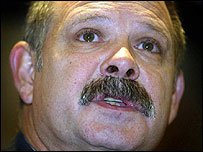
David Ervine


I seem to be writing a lot of obits lately here at hoverbike. It seems to be the time of year for significant passings: James Brown, Saddam Hussein and President Gerald Ford all over the holiday break. Earlier in the year we saw the deaths of Augusto Pinochet, Jeanne Kirkpatrick and Milton Friedman, a trio which will certainly share a corner of hell just as they collectively helped to create hell on earth for so many.

The week before last marked the passing of a strange hero of mine, someone with whom I perhaps shared little ideologically, but nonetheless was deeply affected by and, I must say, admired a great deal. David Ervine, former Protestant terrorist and leader of Northern Ireland's smallest loyalist grouping, the Progressive Unionist Party died two Saturdays ago of heart failure.

Ervine cut his teeth in the brutal world of Protestant paramilitary organizations, an experience about which he was often shockingly frank. The PUP that he led was linked to one of the most vicious protestant terrorist factions, a group that clashed with both Republican forces and the British. It was, he explained, those battles with the supposed protectors of his community, which helped to lead him to the conclusion that the best interests of the Protestant community lay in forging a political solution within Northern Ireland itself. They couldn't rely on self-interested London authorities for protection. His overriding political goal became an end to the bloodshed.

Ervine was never forgiven his crimes by many in the Republican movement. Others, however, saw in Ervine (and the PUP) a Protestant voice which was, at last, political. Unlike the opportunists of Ian Paisley's Democratic Unionists, Ervine embraced the peace process whole-heartedly. He was a firm defender of British dominion, but he articulated a sort of acknowledgement of the nationalist position that was based on a loyalty to Northern Ireland as such as well as a subtle but clear class analysis.

I actually met David Ervine once. It was a strange opportunity arranged for me and my partner by a friend in the Irish Labour movement. A few phone calls were made while we were on vacation in Ireland. Our meeting lasted about an hour. For no good reason, Ervine hosted us in his office at Belfast City Hall, and spent over an hour answering our questions and giving us his perspective on the elusive goal of peace in Northern Ireland. At the time, self rule was suspended, and there was anxiety about whether the political process would hold. Ervine’s wit and honesty were remarkable. It was one of the most profoundly influential moments of my life, both in terms of political thought and moral outlook.

Here I was, and African-American left winger, who spent his adolescence romanticizing the Irish Republican cause with all the attendant naiveté that comes with distance and strong belief. My partner is an Irish American former punk (now scientist) who has always harbored similar nationalistic sympathies. We was sitting in an office sharing tea with a man who had been convicted of acts of violence against both Irish catholic civilians and the United Kingdom itself; a man who was the leader of a party that, while always distinctly working class, included some pretty creepily far-right characters..

And he won us over.

Not to unionism, mind you. I think both of us, for all the say we have in the matter, believe that a united Ireland is a political and moral good. However, what won us over was the sincerity and sophistication of his position. He represented a group of people with legitimate fears and aspirations, including a palpable sense of threat to their survival. They may have had the support of a waning (though still brutal) empire. They still spilled blood in the fight. They may have been relatively economically privileged. They still are largely working-class, and struggle with the same effects of the global economy and shrinking welfare states. Their communities are crime-ridden. The years of civil war have left many of their core institutions corrupt. They were honestly tired of the fighting.

His solution was to reach out, in a careful and complex way, to his counterparts on the Republican side: people who wanted to politicize the struggle, and begin to repair the damage within their communities. Ervine was critical of the Irish American politicians who snubbed Gerry Adams that Saint Patrick’s Day because of IRA intransigence on disarmament. You don’t make progress, he argued, by antagonizing the very people you are trying to bring to the table. Nobody gets to grandstand about terrorism in a situation in which everyone was engaged in terror.


Ervine argued that the hatred and mistrust between the two communities was so ingrained that only when there is a general, society-wide acknowledgement that everyone was to blame, can progress be made. “People always ask me how you can get someone to bomb or kill civilians,” he said. “It’s really easy. All you have to do is go to people and say ‘look what they did. They’ve got to pay for that.’ It’s that easy.”

And so, if you say that a small group of “terrorists” is to blame, you won’t deal with the underlying problems. You also leave a generation of men raised in violence dangerously alienated from society. They have to be part of the solution.

This is something that we saw, first hand, as he arranged a tour for us of Protestant neighborhoods led by a pardoned Unionist terrorist. Organizations representing released prisoners on both sides give such tours regularly, with veterans of the armed conflict giving tours of respective sectarian neighborhoods, and "handing" the tour group off at one of the most infamous checkpoints. In fact, there is a growing commercial trade in tours infamous Belfast conflict zones, decked as they are in colorful and militant murals. Some are more authoritative than others. The economics of tourism Again, however, much to our astonishment, we were given these tours alone, for free, as a personal favor to Ervine.

Our guide on the Unionist side was Noel, who spent several years in prison and was a gunman for the Ulster Volunteer Force. Noel was unsparingly candid, open and genuinely moving in his explanations of the outbreak of violence known as the “troubles”, his own motivations for involvement as well as the tragic outcome for his community. The paramilitary groups, while explained, were never justified or apologized for. There were simultaneous expressions of regret, contrition, pride and hope in his narrative. It may sound ridiculous, but for the first time, I began to see that these people were people, and that they could be represented with a voice that was neither vengeful nor reactionary.

Noel is part of a network of former UVF and IRA militants who now work to diffuse conflict on the ground. They regularly patrol areas surrounding both sides of the “security wall” that separate Unionist from Nationalist neighborhoods. If kids on one side start throwing rocks, a cell phone call puts a stop to it before it escalates. They do the work of the United Nations.

On the Nationalist side, we were handed off to a Sinn Fein activist who worked for a Republican veteran’s organization. I hate to be overly sentimental, but the entire tone of the experience shifted at this point. It may have been that the veterans themselves, who normally give the tours, would have struck a similarly nuanced tone as Noel had. However, our tour was struck in a much more linearly Republican timbre. We were reminded that David Ervine was a murderer. We were given the Sinn Fein perspective on the peace process, which cast doubt on the sincerity of the Catholic and Protestant “moderates” who helped broker the peace agreement. This was interesting in itself, of course, and I understand that Sinn Fein is also engaged in a political strategy. The point, however, was that the contrast seemed to reinforce the special character of a figure like Ervine, and the folks like Noel who followed his lead.

Sinn Fein, for obvious reasons, is still playing the politics of posture, not admitting to any wrongdoing, defending the armed struggle as a necessary response to British and Loyalist oppression. Ian Paisley and other Protestant reactionaries are doing the same thing. Probably, no solution will be workable until the two “extremes” come to some sort of settlement. Thank god, however, that there are people like David Ervine who are willing to call them all out, but also to argue forcefully that all voices must be heard.

Our trip to Belfast was a strange experience all around. We spent the evenings going to bars and clubs where hip young things partied and posed in a world that seemed like it was a planet away from the entrenched, ruitinized conflicts simmering (literally) down the street. It’s a twenty minute walk from the trendy indie-rock clubs full of students to neighborhoods plastered with political murals, where a shopkeeper told us he was stocking up on Union-Jacks for marching season. Because of this contradiction, exacerbated by the tour buses driving past announcing the location of this or that massacre, I sometimes felt like I was in the EPCOT version of Northern Ireland. But, no, it was the real thing. Perhaps the new Belfast will simply swallow up the old one. No doubt economic development and access to education are a good thing. However, we all know that prosperity does not share itself. If old Belfast is to be something new, it will have to grow from old Belfast.

That struggle lost a partisan in David Ervine. R.I.P.

Etiketter: , ,

onsdag, november 15, 2006

now that's party discipline


I'm still working on an analysis of last tuesday. Suffice it to say, I am elated but cautious.

Other news is pressing however, and provides food for thought on our own predicament. South Africa's parliament, thanks to a party-line vote by the ruling African National Congress, has legalized gay marriage. The move was prompted by a high court decision stating that the constitution, perhaps the world's most progressive, demanded equal rights for gay couples.

The majority of South Africans, black, white and "colored" oppose gay marriage. In fact, it is likely that had the ANC allowed its members to vote independently, the vote would have gone quite differently. Most of the opposition parties voted against the new law, including the Pan African Congress and the Inkhata Freedom Party, two of the ANC's rivals among black South Africans.

Traditionalists in the ANC and elsewhere in South African civil society are furious, claiming, as one would expect, that the move would usher in a moral downfall for the continent. Others claimed that the move toward gay rights follows from "foriegn" or "eurocentric" political doctrine.

In fact, the ANC's action was further testament to the notion that, however shaky or imperfect, South African political leadership is deeply committed to the principles of equality. The ANC has strong enough support among its base that it can make risky moves in devense of those principles.

Here's Vytjie Mentor, the ANC leader in Parliament, as quoted in the NYT:


There is “no such thing as a free vote or a vote of conscience,” he said. “How do you give someone permission to discriminate in the name of the A.N.C.? How do you allow for someone to vote against the constitution and the policies of the A.N.C., which is antidiscrimination?”


We have seen this dynamic in South Africa before, with the ANC pushing a line of truth and reconcilliation over revenge after coming to power, as well as their insistance on including women's rights in the new constitution. That document, along with the ANC's own statement of principels includes a radical commitment to social, gender and economic equality, as well as environmental sustainability and protection.

So, can a party win and govern when part of its base is not on board with an ambitious progressive agenda? The ANC demonstrates that it can.

In the US election last week, Democrats pulled significant support from constuencies which are fairly socially conservative. Blacks, latinos and white, male union members all turned further toward the Democratic coalition. Latinos swung a full 30% toward Democrats in comparison to the last election, and blacks remained at their current level: 90% support for Dems. Blacks held firm even as Republicans courted black clergy, offered up socially conservative black candidates, engaged in vote supression and bombarded black neighborhoods with radio ads calling Democrats "the party of slavery". None of it worked, and that's good.

While running socially conservative candidates may have helped in courting white evangelicals and some white males, conservative pundits are grossly overemphasizing this factor. Less reported is the fact that economic populism, minimum wage campaigns and a more critical pose toward trade all helped us win back the parts of our base that Republicans have been chipping away at for decades.

The Democrats are not the ANC. We don't have a parliamentary system or a political culture that even allows the sort of party discipline on display in South Africa. However, what we can learn is that standing up for minorities' rights doesn't have to cost you a majority if you really give people a reason to vote for you.

Etiketter:

tirsdag, september 19, 2006

will the swedish model hold?


The answer to my own wonky question is "yes". Sunday's electoral victory by the right-wing "Alliance" of four parties was a defeat for the valliant but tired Social Democratic Party. It was not a defeat for Social Democracy. Still, it's not a good thing. While the new majority is somewhat slim (7 seats), it will likely survive a full term. They'll do some damage, on integration questions, on macro-economics, labor rights and probably foreign policy.

However, their victory required a major concession: the acceptance of the basic governing tenants of Social Democracy. In fact, the conservative Moderate Party, the dominant player in the Alliance, campaigned, Blair style, as "the New Moderates". Their move to the center brought in middle and working class votes that would not have been theres had they stuck to their traditional neoliberal talking points.

Nonetheless, even though the mandate is small at the national level, it was a mandate. In fact, at the local level, (local and national elections were held simultaneously) the Moderates took control of scores of city and regional governments, including Stockholm and Gothenburg. While the Social Democrats did perform better than was expected several months ago, the Moderates' surge in popularity was decisive.

There were interesting trends among the smaller parties, as well. Neither the Social Democrats nor the Moderates will ever recieve enough votes to govern absolutely. The Social Democrats rely on the "toleration" of the sometimes quixotic Greens and the Left Party. Neither minor party is allowed into the Government, so it is not technically a Coalition. While the Greens perennially make noise of breaking with the Social Democrats, they always end up listening to their base and voting in a minority Social Democratic government. The Left Party can also be a pain in the ass. Shortly after the last election, their popular and quite strategic was forced to resign due to a personal tax scandal. Her replacement, from the paleoleft faction of the party, decided to announce last year that he was, in fact, a "Communist." Then he recanted, becoming the only thing worse than a Communist in Swedish politics: a disloyal, dishonest Communist. Their vote was down considerably this time around.

In Sweden, Right Wing governments are always true coalitions, led most times by the Moderates, but with government ministers from the other so-called "bourgeois" parties: the liberal People's Party, the agrarian Center Party and the Christian Democrats. The People's Party has also participated in governments of the left, and include a healthy faction of left-leaning "social liberals" (these folks are probably the closest to our Democratic Party in Sweden). In the last elections, the liberals did very well by moving to the right on immigration and integration questions. It was a craven move, but it paid off. For the first time, it seemed that the People's Party would be the new leading party of the right. This year, they got caught spying on the Social Democrats. They lost a lot of ground.

It was the Moderate Party who were back in the forefront, and their leader, Fredrik Reinfeldt, is the new Prime Minister. Right wing governments don't usually last long in Sweden. Generally they try too hard, and over-extend their mandate. The fact that they are always coalitions makes them even more unstable: the Christian and agrarian vote won't let them go after the Welfare State too aggressively and the liberals demand radical moves on social issues. Not an easy recipe for a coherent strategy for governance.

But this new "Alliance" seems a bit more disciplined and truly eager to govern. They have resonated the same themes on the campaign trail, they've stuck to the script, and they seem to have hammered out key turf issues well in advance. Most importantly, they've campaigned as centrists, as modernizers, as having accepted the basic Swedish lay of the land. They are, in that sense, akin to our own Governor here in California. We know that he has proven much more difficult to beat, even though his agenda is usupported by the majority of Californians. He's a "moderate" Republican. Nonetheless, he continues to sneak right wing policies quietly past the goalie. Beware these "moderates", old or new.

The Social Democrats and the rest of the Swedish left needs to do some serious thinking whilst sitting in opposition. It's possible that this bunch can't be counted on to simply lose the next election for us. The next one will have to be won.

Here are the results, via our friends at The Daily:

Percentage vote on the left, Riksdag seats on the right, change in brackets.

Left Party 5.8% (-2.5%) 22 (-8)
Social Democrats 35.2% (-4.8%) 130 (-14)
Greens 5.2% (+0.6%) 19 (+2)

Total Left bloc 46.2% (-6.7%) 171 (-20)

Centre Party 7.9% (+1.7%) 29 (+7)
Liberal Party 7.5% (-5.9%) 28 (-20)
Christian Democrats 6.6% (-2.5%) 24 (-9)
Moderate Party 26.1% (+10.9%) 97 (+42)

Total Bourgeois bloc 48.1% (+4.2%) 178 (+20)

Others 5.7% (+2.6%) 0 (-)

Etiketter:

lørdag, september 09, 2006

europolitics round up


Sweden.

Well, there's just a few days to go until Swedish parliamentary elections. The two party blocs are still polling neck in neck, with the left (made up of the Social Democrats, the Left Party and the Greens) slightly ahead. The good guys' fortunes were recently improved when it was revealed that the Liberal Party (on the Right in Sweden) had been hacking into the Social Democrats' private network to get info on campaign tactics and schedules. It's good to see that all parts of the American campaign toolbag is being exported, including Richard Nixon's contributions.

Critics are calling the scandal "Leijonborggate" after charismatic Liberal Party leader Lars Leijonborg. Confusingly, the word also means "Lejonborg Street", but I guess the "-gate" suffix is now universal. What is most striking is that somehow Swedes are angry about such shenanigans, while American voters are bored by evidence that an entire election has been blatantly stolen. Twice. Oh well.

Great Britain (And Northern Ireland)

Accross the North Sea in Britain, pressure is mounting for Tony Blair to step down. As previously reported, the heir apparent is still Gordon Brown. Blair has now said that he will step down within a year, though that's not good enough for some on the Labour back bench or among some of the membership. Read more about it, and other goings on in the UK over at The Daily.

In other British news, former US President Martin Sheen has entered the Freshman class at Glasgow University. He'll be studying Literature, Philosophy and Oceanography.

Federal Republic of Germany
In a move hinted at by Ben in a comment on my last post, German automaker Volkswagen is pressing workers to accept longer hours without pay increases. I always like to read sentances like this one:

"Although Volkswagen's cars are proving popular and sales are very strong, its profit margins are being squeezed by high production costs, particularly in its west German heartlands."

So, here in the US, we are being asked to accept drastic pay cuts (as much as 70%) because of lagging sales, while in Germany, amid high sales, we are being asked to work harder and longer. Gotta love market logic.

Etiketter:

tirsdag, juli 25, 2006

to the euston station.... the left and universal human rights

The left has often found it difficult to resist the notion that our enemy’s enemies are our friends. From the defense in some parts of the left of every move the Soviet Union made, to the 60’s fetishization of the National Liberation Front in Vietnam, to the softer mistake of lifting Hugo Chavez to sainthood, we often seem to believe that any force which opposes the United States must be a good thing. Thankfully, most of us have not made this mistake in the current “war on terror”. This isn't true for everyone, of course. For example, the always overrated Naomi Klein let her enthousiasm for brown people with guns get the better of her when she wrote a much-attacked celebration of the Mahdi Army in Iraq. She found a way to triangulate around the simple fact that a victory for the Iraqi "resistance" would lead to the repeal of most of the Iraqi people's hard-won gains for women, workers and intellectual freedom.
Similarly, just as some Zionists employ a double standard about Israeli vs. Palestinian violence, there are those in the American left who simply reverse this double standard. Suicide bombings are regrettable, but the “real” problem is Israeli military action. Zionism is racism, but the rampant and disgusting anti-Semitism among Muslims and Arabs is understandable. In my view, they are both “the real problem”.
It is understandable that we would want to support resistance movements opposing occupations and atrocities committed with our tax dollars, but not all resistance movements are born equal. I am no pacifist, and believe that all people have the right to self-defense, even military. However, just as we would be critical of Israel’s choices in defense of its nationhood, so, too should we keep our wits about us when analyzing the motivations, behavior, ideology and strategies of movements opposing U.S. or Israeli policy in the Middle East.
That’s why I lost all respect for George Galloway after his recent speech at a march in London opposing Israeli terror-bombings of Gaza and Lebanon. You may remember Galloway, the articulate British MP who spoke to Congress last year, defending himself from allegations of aiding terrorism, and told them to stick it. He became a brief celebrity among liberals and progressives here, as we had not heard an elected Democrat speak forcefully about anything in so long. Galloway’s always been a bit nutty, but he jumped the goddamn shark when he exclaimed at the March that ''I am here to glorify the resistance, Hezbollah. I am here to glorify their leader, Sheikh Hassan Nasrallah''. That was simply indefensible, especially given that the city of London is still recovering from a series of home-grown terror attacks which killed scores of working-class people.
As this sort of nonsense has gained ground in parts of the UK left, a group of intellectuals, activists and bloggers have issued a statement of principles known as the Euston Manifesto. Essentially an appeal for a renewed commitment to fundamental human rights, the document criticizes both anti-Semitism and anti-Americanism, as well as the strange sympathy some on the left have toward Islamist movements. The Manifesto has been criticized for being waffly on the Iraq war, (in truth it is mostly silent on the issue, as authors are split on the question), and has been characterized as a right-wing document. Read it, and decide for yourself. Personally, I see the statement, which has been signed by a number of prominent American social democratic thinkers, as an important corrective to some of the more dangerously simplistic and authoritarian tendencies on the left. It may sound strange, but we do need to lay out a clear statement of principles regarding universal human rights. The real world is complex, and, contrary to George Bush’s bedtime stories, it is not divided clearly into good guys and bad guys. People living under repressive regimes must make difficult choices: however, it is important not to degenerate into an absolute moral relativism of the left- supporting anything that is against U.S. power, for example, or which wraps itself in the rhetoric of socialism or anti-globalization, whatever those words actually mean.
We know that the right plays this game all the time. Any regime that is “anti-terrorist” or “anti-communist” can be apologized for: which is how both Pinochet and Saudi Arabia became our best friends. Let’s not make the same mistake.

See a clip of Galloway's speech here.


More of Naomi Klein's Judgements, "Bring Najaf to New York". I don't know about you, but I don't want to bring Najaf to New York.

Etiketter: , ,

after blair


If the prevarications of the Clinton era have left center-to-progressive politics in noticeable disarray, the same can be said for the legacy of Clinton's cousin across the pond, Tony Blair. Blair's attempts to dismantle the Labour Party's ties to it's traditional bases in the trade unions and the new left may have created a considerable, but unstable electoral majority- just as Clinton's triangulation afforded the Democrats our only two-term president in my lifetime. As any hoverbike reader knows, I have serious doubts that the centrist strategy is good for our side in the long run. Life after Clinton has been hard for the Democrats, and the broad left, as we struggle to figure out what a progressive message, let alone progressive governance, looks like in the twenty-first century.
Blair's inevitable departure as Party Leader (and Prime Minister) is setting the stage for a political battle that, mirroring the 2004 Presidential Primary, will be a referendum on the meaning and consequences of the New Labour project. The heir apparent, Chancellor Gordon Brown, represents the segment of the party which is more traditional (and progressive) than the hard-core of New Labor, but which has gone along with Blair's rightward drift for the sake of victory and party unity. Most analysts believe that a Labor Party under Brown will continue the generally centrist approach of the current government, while strengthening slightly the commitment to the welfare state, trade union rights and a social justice-based trade policy. Even this difference, however, has been in question of late as Brown seems to be signaling his own shift to the right. Other voices (and potential Leader candidates) have emerged, however, positioning themselves as heralds of a more decisive shift to the left.
The darlings of the far-left blogosphere (think of them as somewhat akin to Dennis Kucinich) are John McDonnell and Michael Meacher. McDonnell has attracted attention and some key commitments from some of the grassroots. Meacher has nabbed some headlines for adding his voice to the 911 conspiracy chorus. Neither candidate is likely to win, given the powerful role that the party’s parliamentary group plays in selecting a leader. In the case of Meacher, that’s probably a blessing.
Other floating names include two cabinet members, John Denham of the Home office and Peter Hain, the Northern Ireland Secretary. As is the case here, the Iraq war looms heavily over the leadership question. The Party’s grassroots are strongly anti-war, and Blair’s continuing support for the Bush Administration’s policies has angered the base as well as a large percentage of Labour members of parliament. There have been high-profile cabinet resignations, as well as an upsurge in support for anti-war parties both to the left and the right of Labour. There is certainly an argument to be made, as it is here, that to be the leading party of the center-left, Labour must have a coherent, and progressive position on the war, while remaining credible and pragmatic on the overall question of national defense. That’s not an easy line to walk, but Blair’s lap-dog routine only works so long as the Conservatives don’t provide a viable alternative.
In Bush, the Republicans found just such an alternative. The new Conservative leader, David Cameron, is looking more and more like a serious challenger. In the next British election, Brown may well end up joining Al Gore as the failed continuation of the “Third Way” model. Only a strong and compelling reason to vote Labour will stop that from happening, and an internal challenge from the left of the party may be what it takes to force Brown to campaign on the Party’s strengths, instead of the Conservatives’ weaknesses. Let us just pray that he doesn’t put in a call to Kerry’s advisors.

To follow the Labout Party’s leadership saga, check out the daily, a fantastic new blog from which I blatantly stole much of the above analysis and information.

Etiketter: , , ,